Thursday, December 15, 2011

Realities of Religion and Politics

We the people.  What wisdom in such a simple yet meaningful concept.  Unfortunately, the promise of equality too often falls short to profit and segregation.  Too often we make short-sited decisions in favor of personal greed instead of providing a foundation for a healthy, happy and sustainable society.  Too often we forget that we are a part of a community.  We forget that we are a people.  We forget that we are one world.
Fear has often driven this forgetfulness.  Fear of not having enough.  Fear of being wrong.  Fear of others.  Fear of the unknown which keeps us complacent.  Fear often proves to be a motivating factor in establishing laws that protect what financial gains we have.  Fear keeps the wealthy…wealthy.  Fear keeps us from understanding those that are not like us.  Fear sends us to war and keeps us at war.  Fear builds fences. 
Historically speaking, fear has caused massive bloodshed.  Take a look at Somalia, Kosovo, Rwanda, the Holocaust, Aboriginal Child Removal Policy (Australia), Indian Removal Act (North America), the Inquisition, Witch Trials, etc.  Unfortunately, this is only a short list.  After reading the list, what do you think?  Are those all things of the past? 
On December 12, 2011, Amina bint Abdel Halim Nassar was executed for sorcery and witchcraft in Saudi Arabia.  She was beheaded for blasphemy.  Unfortunately, that’s only one example of the destruction fear causes in the daily lives of worldly citizens.  It’s unfortunate that these things have happened, but it’s unfathomable as to why they continue to happen.  How can we put a man on the moon, discover the double helix, or describe quantum physics and still be so utterly ignorant? 
Knowledge of what is good is nothing new. 
“To see what is right and not do it is want of courage.” – Confucius
“I am not Athenian or Greek, but a citizen of the world.” – Socrates
“All that is necessary for the triumph of evil is that good men do nothing.” - Edmund Burke
Yet too often, we do nothing.  Too often, we choose to be blind and dumb.  Too often, we find bliss in reaffirming ignorance. 
It’s reaffirming to find a congregation that thinks the way we do and oh what a coincidence that it’s exactly what god wants.  The town of Keyser, WV has a population of 5,303 as of 2000.  It also has 4 different United Methodist Churches (let alone all the other denominations).  They were, and primarily still are, the Methodist Episcopal Church, The Methodist Episcopal Church South, the African Methodist Episcopal Church and the United Brethren Church.  Each one maintains a slightly different socio-economic status and viewpoint, yet each one supports the “true” meaning of god’s will.  Keyser is not an anomaly. 
Some doctrines claim that homosexuals are living in sin.  Some say blasphemy should be punished by death.  Some say people of a different race are inferior.  Some say god blesses the wealthy.  Some think god helps a sports team win a game.  Some believe in stoning sexually active women.  Some believe that anyone who doesn’t believe like them should be killed.  All are confirmed to be most righteous.  All are living the true desires of their god.  Based upon personal affirmation all of them can do as much good or bad and claim to be right. 
This is the danger of allowing religious beliefs to govern society.  In this type of society, people make laws not because it’s right, but because a book or a person tells them to do so.  If it takes a book or religious belief to convince our political representatives that it’s wrong to cheat, steal or kill, then we should be ashamed to foolishly elect them. 
We know what is right.  We know what is wrong.  We can see…but will we speak?

Wednesday, December 14, 2011

Santa Fe

All I need in life is sustained happiness.  When I’m happy, I have something worth living for.  Oh sure, there will be some hard times and some unpleasant moments but overall, life is full of joy and gratitude when you have the foundation of love from another.  All the trinkets that one could buy in this developed world are worthless when compared to the gift of sincere and undiluted love.  Of all the things that could consume one’s time during their waking days, nothing compares to the simple moments shared with the one that makes you smile.  This posting is a heartfelt thank you to my partner on this awesome journey called life. 

Santa Fe, holy faith, sacred belief, the foundational essence that keeps you smiling each day; that’s what I think of Jeri, my wife.  Part of the inspiration for this posting comes from the music video of the song Santa Fe by Beirut.  I highly recommend watching, listening and hitting the replay button.  Whoever or whatever serves this role in your life, hold on to it.  Always remember how the simple smile is all you need to not only keep going but to enjoy life’s journey. 

The video starts off with sadness, but there’s more.  The protagonist is lifted from the depths of sorrow by his Santa Fe and life becomes worth living again.  He remembers the sheer joy of just being with his Santa Fe, playing on the beach without a care in the world.  He remembers the joy of sharing a simple meal with his partner and his friend.  He remembers how grand moments in time can be when shared with the ones that make your life worth living.  These moments are what make life…life.  The love of another helps make life ever so vivid no matter the situation.  Having a Santa Fe and being a Santa Fe are what allows one to keep finding the joy in even the hardest of situations.  It also makes those high times feel as though you’re in an all-encompassing paradise.

Live in these moments.  Remember these moments. Be inspired by these moments.  Live…smile… laugh…love…remember.


Wednesday, December 7, 2011

Scarcity

I remember the story being told by my mom on a few occasions and it always brings a smile to my face.  I say I remember the telling of the story and not the actual event as I must have been about 2 years old at the time.  The story... toilet training.  Here is how I remember the story…

My dad is a budgeter.  He had (and still has) a budget for everything, including my disposable diaper allowance.  Since it was apparently becoming time for me to be weaned from diapers, my dad decided to have a conference with me.  He took me to his storage closet, filled with whatever supplies were needed for the house (toilet paper, batteries, light bulbs, diapers, etc.) and showed me the stack of diapers.  To a 2 year old, that stack of diapers appeared to be all the diapers that could possibly exist in the world.  He calmly informed me that when that stack was gone there would be no more diapers.  At that point I would simply have to use the toilet with no alternatives. 

I don’t recall what I thought as a 2 year old, but it must have been clear to me that there was a definitive limit to the diaper resources of my world.  It was so clear, evidently, that when that day of the last diaper arrived I accepted it without incidence.  I simply started using the toilet.  There was no other option. 

Now again, I was just a toddler with no real recollection of the events, but I’ve heard the story enough and it has a moral that I think deserves to be shared.  The moral, of course, is to use your resources wisely.  We live in an abundant world, yet it is definitively limited.  We will run out of resources at some point.  Someday, there will be no more diapers to absorb our mess.

If we use something today, then we won’t be able to use it tomorrow.  If we as a society use limited resources today, then we will leave a future world without the opportunity to use those resources.

We will run out of oil.  We will run out of money when we maintain a negative savings rate.  We will run out of opportunities to do the right thing.  We will run out of time. 

How do you want to live your life?  How do you want to be remembered?  How do you want to affect others?  How do you want to spend your day?  How do you want to spend your time?  …It’s probably time to start.  Time is getting scarce.  

Spend as much as you need

Americans have set an unprecedented level.  We are officially a league above any other nation and there is no evidence that this trend will change anytime soon.  That’s right; we are the kings when it comes to spending money.  Our consumption motto has been, “Savings?  We don’t need no stinkin’ savings.”  But why?  Why do we spend so much with no real meaningful thought towards tomorrow? 
Princeton professor Sheldon Garon tackled this question in his book, Beyond Our Means: Why America Spends While the World Saves.  His interview with NPR can be read here.  The gist, however, is that America has institutionalized incentives towards debt while many Western European and Eastern Asian countries have institutionalized incentives towards savings.  Many of these forward thinking practices of our worldly neighbors include government subsidies towards small savings accounts.  The government actually supports paying increased interest on individual’s savings account.  This encourages people to actually save and be more intentional about using their monetary resources. 
Let’s look at a couple of ballpark figures as of today (a quick Google search would confirm)…

Type
Interest rate in America
Interest rate in Western Europe
Simple Savings Account
.05%
2.5% to 3%
1 year CD
.5% to 1%
4% to 4.5%


Yes we spend statistically significantly more than our worldly neighbors, but we have also created and supported a society that doesn’t encourage the masses to save.  Conversely, we actually find it more convenient to keep the masses in debt. What do we do instead of encourage savings?  We actually subsidize lending institutions to lend extra credit to the masses to encourage them to spend more than they really have. 
Specifically, we subsidize the lending practices of a wide array of mortgage companies by offering the masses home equity loans.  With these loans, starting in 1986, we created a system that allowed tax exemptions for home equity loans, just like with original mortgages.  This encouraged people to take out second and even third mortgages on their homes so that they could maintain their spending lifestyle.   After the 1980’s, it became common place to find government approved and encouraged lending practices of up to 125% of the home’s value in home equity loans for whatever people wanted.  If someone couldn’t qualify for a bank loan, there became a multitude of options from the private sector.  Again, all of these loans were and are still provided with tax deductible interest, encouraging people to not only remain in debt, but also not fear debt. 
Lenders have treated the borrowing consumers as cash cows.  The borrowers have been trained to use these ways of “creating” money to help them through whatever budget dilemmas they may have.  With this mentality of debt is okay, even good, we find a society with deregulated lending practices that keep the masses in debt and dependence.  Credit card companies were also deregulated in the 1980’s and they were given the green light to charge customers whatever they wanted.  People found more and more options for credit that they eventually decided (consciously or not) that there was no need to pay off a house or reduce debts when finding credit is so extremely easy. 
These greater profit seeking practices have contributed greatly to a society that spends beyond their means.  It has also resulted in a fundamental shift of monetary resources from the have-nots to the haves.  Our widening income and wealth gap is big enough of a problem.  There is no need to facilitate it…yet we do. 
The good news is that the solution is easy.  Spend less.  Spend according to your means, not beyond them.  Yes, we should institute some of these societal wide incentives to save (like actual interest for a savings account), but you can choose not to borrow money that you don’t need.  We don’t “need” all the latest gadgets and extra toys that we find ourselves buying all too often.  If we find ourselves not needing to spend so much money, then we’ll also find ourselves not needing to make so much money.  We don’t have to take extra resources from others (people, the environment, etc.) just to support an unnecessary lifestyle. 
We won’t have to spend so much time focused on work that we forget about the things that really motivate us in life.  We can afford to take a less stressful and more enjoyable job when we aren’t dependent on the high salary to pay for our fast cars and enormous houses (all on the payment plan).    We can free ourselves from a seemingly inescapable cycle of debt and dependence if we just live according to our needs and means.  I think we would all be happier this way…and the planet would too.

Thursday, December 1, 2011

Make as much as you need.

Obvious gaps in income and wealth distribution has been at the crux of social unrest for thousands of years. The classic battle between the Haves and Have-nots has plagued societies for as long as societies have been around. Many of us have heard the numbers, but few of us do anything about them. Why? Well, there are several reasons, but among them is the fact that the ones who find themselves empowered to make a difference are usually the Haves, and they choose not to give up their excess. In a global community that equates money with security, it makes sense that even the secure Haves wouldn’t want to give up potential security. Additionally, I think it’s easier to ignore the reality of the numbers when we pick and choose who to compare ourselves against. For example, it has been popular to compare ourselves to greedy, top 1% income receivers and feel justified in our assessment that we are not part of the problem. We should probably look at a couple numbers…
The following numbers are from Branko Milanovic of the World Bank in 2002.
  • An American who earns an average income among the bottom 10% in the USA is better off than 2/3 of people worldwide.
  • "The top 10 percent of the US population has an aggregate income equal to income of the poorest 43 percent of people in the world, or differently put, total income of the richest 25 million Americans is equal to total income of almost 2 billion people."
  • The rate of the income of poor people (with less than 3,470 US$/year) is 78 %. The rate of the income of rich people (with more than 8,000 US$/year) is 11 %.
  • With regard to wealth inequality (researchers defined wealth as the value of physical and financial assets minus debts. - "only $2161 was needed in order to belong to the top half of the world wealth distribution, but to be a member of the top 10 per cent required at least $61,000 and membership of the top 1 per cent required more than $500,000 per adult." (Davies, The World Distribution of Household Wealth, 2006)

How can this be? How can a minimum wage job in the USA generate an income that is among the top 10% earners in the world? Well, obviously the USA and other rich countries have a lot of wealth. We live in the land of the Haves. Even though we may compare ourselves to the Jones-es and feel as though we don’t have enough, we are still earning money that many on this planet can only dream about. We don’t have trouble with starving citizens but rather obesity, diabetes, heart disease and other ramifications of a sedentary lifestyle with massive amounts of cheap “food” available. We have so much that we are actually hurting ourselves by the excess.
More is not better. Bigger is not better. Better is better. We live in a land that has lots of cheap food and gadgets that are to be consumed over and over again. With the continual purchasing and consuming of these items, we are providing continued income for the Haves of the Have societies. With this mindset that more is better, we are also forgetting the purpose of money…security. We need money to help provide some of the security we need for basic needs and enjoyments in life. Money is not an end in itself. More stuff is not an end in itself. Security, freedom, enjoyment of life’s experiences…these are the things I think we all really want.
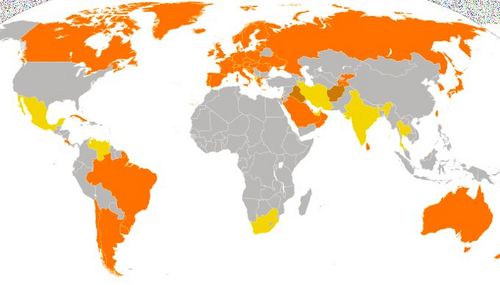
Instead of making as much money as you can, why not make as much money as you need? If we focus on what we need, not who we can make more than, then perhaps we can focus on real solutions to the obstacles that face societies. With all this excess that we have available it would only make sense to institute societal programs like universal health care. Like these countries…

 (July 2009).

  Nations with some type of universal health care system.
  Nations attempting to obtain universal health care.
  Health care coverage provided by the United States war funding.
  Nations with no universal health care.


We have a lot. There are plenty of resources out there to sustain human life. We’ve been doing this for thousands of years now. We have so much these days that we have to stop to ask ourselves what are we making all of this money for? Why do we need bigger houses, trucks, TVs, etc.? Why do we need more stuff?
We need more peace. We need more equality. We need more sustainable societies that find effective ways to provide for everyone’s basic needs as well as opportunities for individual freedoms. We need only so much money to satisfy these goals.